

Blood Flow Restriction Training: The Complete Guide

If you have ever been told you need to rebuild muscle after surgery but cannot yet handle heavy resistance, or that your joints are too compromised for traditional strength training, you know the frustration of being caught between two difficult realities: your body needs to get stronger, but the most common tools for doing that are off the table.
Blood Flow Restriction training was developed precisely for that gap. It is one of the most clinically studied rehabilitation techniques of the past two decades, and when used correctly by a licensed physical therapist, it allows patients to make real, measurable strength and muscle gains at loads that would otherwise be far too low to produce any meaningful adaptation.
This guide covers everything you need to know: the science behind it, the conditions it helps, what a session actually feels like, and how the clinical team at Synergy Physical Therapy in Scottsdale, AZ uses it as part of individualized rehabilitation programs.
What Is Blood Flow Restriction Training?
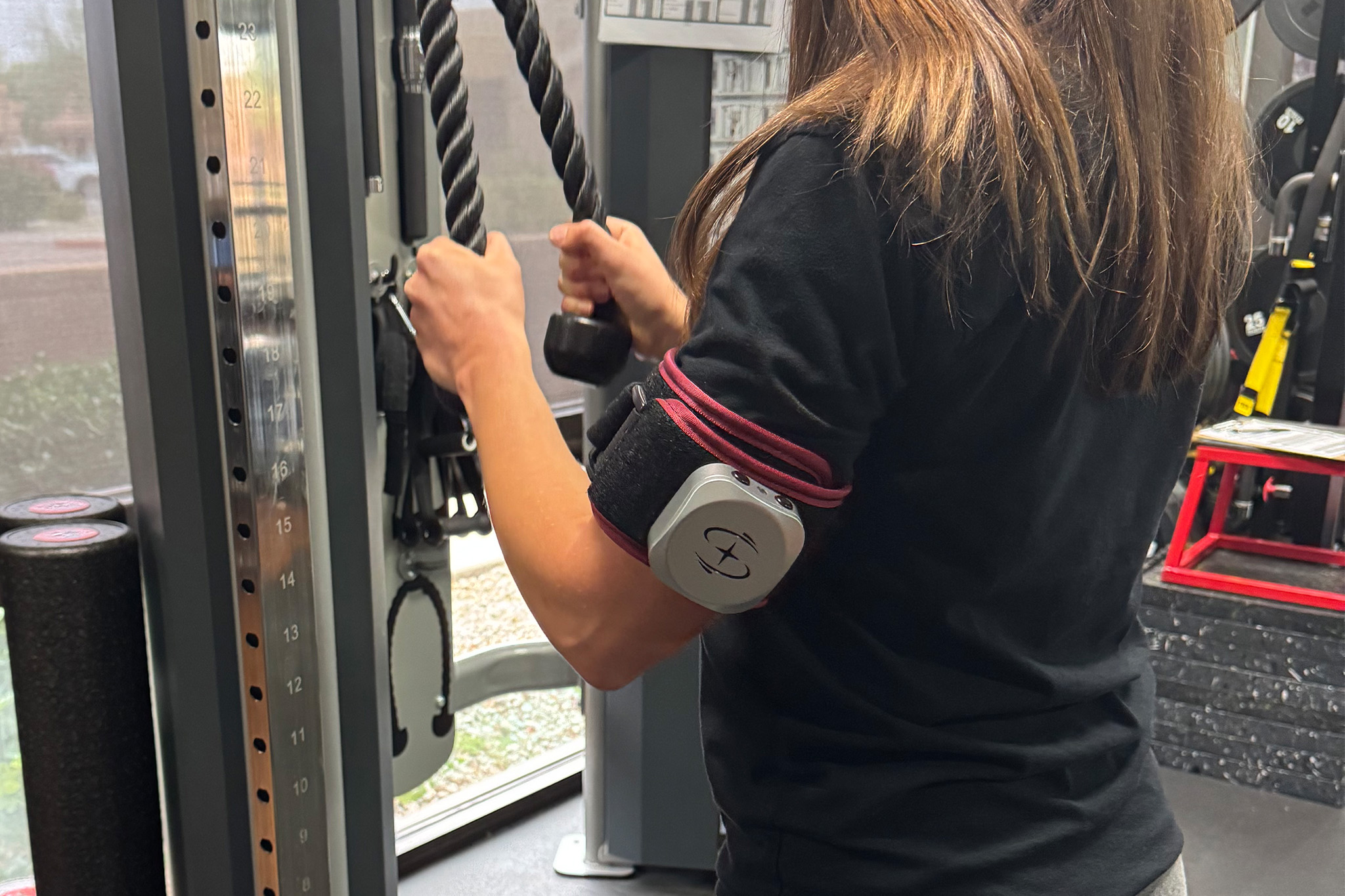
Blood Flow Restriction training, commonly called BFR, is a rehabilitation and strength training technique that uses an inflatable cuff or wrap applied to the upper arm or upper leg to partially restrict venous blood flow out of the limb during exercise. The arterial blood flow in continues; the venous return out is slowed. This creates a specific physiological environment inside the muscle that mimics, at the cellular level, what happens during high-intensity resistance training.
The technique was first developed in Japan in the early 1970s by researcher Yoshiaki Sato, who formalized it into a protocol called KAATSU training. Over the following decades, the approach was studied extensively by sports medicine and rehabilitation researchers worldwide. Today, BFR is used in orthopedic rehabilitation clinics, military medical centers, professional sports organizations, and physical therapy practices across the United States.
BFR allows patients to stimulate muscle growth and strength at loads as low as 20 to 30 percent of their one-repetition maximum — a threshold that would produce little to no adaptation under normal training conditions.
The clinical appeal is straightforward: most patients who need to rebuild muscle are doing so because their injury, surgery, or condition has made high-load exercise painful, unsafe, or otherwise contraindicated. BFR provides a path to meaningful strength gains without requiring those loads.
How Does BFR Actually Work?
The mechanism behind BFR involves several overlapping physiological pathways. Understanding them matters, because it explains why BFR produces results that seem disproportionate to the load being used.
Metabolic Stress
When venous return is restricted, metabolic byproducts from working muscle tissue, including lactate, hydrogen ions, and inorganic phosphate, accumulate in the muscle rather than being cleared. This metabolic environment signals the body to upregulate muscle protein synthesis and recruit larger, fast-twitch muscle fibers that would not normally be activated at low loads.
Cellular Swelling
The restriction of venous outflow causes fluid to pool in the muscle cell, creating a state of cellular swelling. Research suggests this swelling is interpreted by the cell as a mechanical threat, triggering anabolic signaling pathways including mTOR activation — the same pathway engaged by heavy resistance training.
Hormonal Response
BFR exercise has been shown to increase systemic levels of growth hormone significantly more than equivalent non-restricted exercise. This hormonal response contributes to the muscle hypertrophy and recovery effects observed in clinical studies.
Motor Unit Recruitment
As fatigue accumulates rapidly under BFR conditions, the nervous system progressively recruits higher-threshold motor units to maintain force output. This is the same recruitment pattern seen in heavy resistance training, and it is a key reason BFR produces strength adaptations at low loads.
What the Research Says
BFR is not an experimental technique. It has been the subject of hundreds of peer-reviewed studies over the past two decades, and the evidence base is well-established in several areas.
Research published in the Journal of Strength and Conditioning Research, the American Journal of Sports Medicine, and multiple physical therapy journals has consistently demonstrated that BFR produces statistically significant improvements in muscle size and strength in populations including post-surgical patients, older adults, and individuals with osteoarthritis.
A 2019 systematic review and meta-analysis found that BFR training produced muscle hypertrophy comparable to traditional high-load resistance training in healthy and clinical populations alike. A separate body of research has validated its safety profile when applied by trained clinicians using individualized occlusion pressures.
Importantly, the research also makes clear that BFR is not a universal solution. Its benefits are well-documented for specific populations and conditions. It is most effective when integrated into a comprehensive rehabilitation program rather than used in isolation.
Conditions BFR Can Help
BFR training is most appropriate as a rehabilitation tool for patients managing conditions that limit their ability to perform conventional high-load resistance exercise. At Synergy Physical Therapy, BFR may be incorporated into treatment plans for patients with the following:
BFR has also been studied in the context of age-related muscle loss (sarcopenia), where older adults who cannot safely perform heavy resistance training have shown meaningful strength improvements with supervised BFR protocols.
Who Is — and Is Not — a Candidate
Not every patient is a good fit for BFR, and a responsible clinical approach requires honest assessment of both indications and contraindications before recommending it.
Patients Who May Benefit
BFR is most appropriate for patients who are in a phase of recovery where joint loading must be minimized, who are experiencing significant muscle atrophy following injury or surgery, or whose condition — such as osteoarthritis — makes high-load exercise painful or harmful. Older adults who cannot safely train at high intensities are also frequently good candidates.
Patients Who Are Not Candidates
BFR is contraindicated for patients with a history of deep vein thrombosis (DVT) or clotting disorders, uncontrolled hypertension, peripheral vascular disease, open wounds or skin infections in the area where the cuff would be applied, or known cardiac conditions that would be exacerbated by the hemodynamic effects of BFR. Pregnancy is also a contraindication.
At Synergy Physical Therapy, every patient receives a thorough clinical assessment before BFR is introduced. The technique is only recommended when it is the right tool for the right patient at the right stage of recovery.
It is also worth noting that BFR should always be applied using individualized limb occlusion pressure, meaning the cuff pressure is calibrated specifically to your anatomy and vascular response, not set at a generic level. This is one of the most important safety distinctions between BFR applied by a trained clinician and informal or unsupervised use.
What to Expect During a BFR Session
For most patients, the first BFR session includes an explanation of the technique, an assessment of candidacy, and a conservative introductory protocol to gauge response. Here is what a typical session looks like:
Cuff Application
A specialized pneumatic cuff is applied to the proximal portion of the limb being trained — typically the upper arm or upper thigh. The cuff is inflated to a pressure calibrated to your individual limb occlusion pressure, typically between 40 and 80 percent of full occlusion. You will feel pressure, similar to a blood pressure cuff, but it should not be painful.
Exercise Protocol
You will perform sets of low-load exercise, often bodyweight or lightly loaded movements, with short rest intervals between sets. A common protocol is four sets structured as 30 repetitions, then three sets of 15, with 30 to 60 seconds of rest between sets. The short rest is intentional: it maintains the metabolic environment that drives the adaptation.
What You Will Feel
Most patients experience significant muscle fatigue and a burning sensation during the exercise sets, out of proportion to the load being used. This is expected and is part of the mechanism. Your therapist will monitor your response throughout and adjust if needed.
After the Session
The cuff is removed at the end of the protocol. You may experience muscle soreness over the following 24 to 48 hours, similar to what you would expect after a resistance training workout. The skin beneath the cuff may be temporarily reddened, which resolves quickly.
BFR vs. Traditional Strength Training
It is worth being direct about what BFR is and is not. It is not a replacement for traditional resistance training for healthy individuals who can train conventionally. For patients without contraindications, high-load training remains the gold standard for building strength and muscle mass.
What BFR provides is a clinically validated bridge: a way to maintain and rebuild muscle when traditional loading is not yet possible. For patients in early post-surgical recovery, or managing chronic conditions that limit loading, it fills a gap that would otherwise mean prolonged atrophy and delayed return to function.
The practical distinction for most rehabilitation patients is this: with traditional training, meaningful muscle adaptation generally requires loads at or above 60 to 70 percent of one-repetition maximum. For a patient six weeks out of ACL reconstruction, that threshold is often not achievable safely. BFR makes meaningful adaptation possible at 20 to 30 percent of that threshold — loads that are safe at that stage of healing.
How Synergy Physical Therapy Uses BFR
At Synergy Physical Therapy in Scottsdale, AZ, BFR training is one tool within a broader clinical framework, not a standalone treatment or a protocol applied by default. Our licensed physical therapists assess each patient individually to determine whether BFR is appropriate, and if it is, how it fits into a comprehensive plan alongside hands-on manual therapy and progressive exercise.
We do not use BFR because it is trending. We use it when the clinical picture calls for it: when a patient needs to rebuild strength, cannot yet tolerate conventional loading, and has been assessed as an appropriate candidate. When those conditions are met, BFR is integrated carefully and monitored throughout.
Real rehabilitation results come from complete, individualized programs. BFR, when indicated, accelerates one critical part of that process. It is never positioned as the whole answer.
If you are recovering from surgery, managing a chronic musculoskeletal condition, or dealing with significant muscle weakness and are located in Scottsdale or the surrounding Phoenix metro areas, our team is available for a free new patient consultation to determine what approach is right for your situation.