

Neck Pain and Headaches: Why They Are Connected

You have had headaches for years. You have tried medications, you have tried rest, you have tried drinking more water and cutting back on caffeine. Some things help a little. Nothing fixes it. The headaches keep coming back.
What a lot of people in this situation have never been told is that a significant proportion of chronic headaches, particularly those that involve neck tension or pain, are actually originating from the neck itself. The headache is a symptom. The cervical spine is where the problem lives.
This is called a cervicogenic headache, and it is one of the most underdiagnosed and undertreated conditions in primary care. It is also one of the most effectively treated conditions in physical therapy. If you have chronic headaches and a stiff, sore neck, understanding this connection could change how you have been thinking about a problem you may have been living with for a very long time.
The Connection Most People Do Not Know About
The upper part of the cervical spine, the top two or three vertebrae of the neck, shares nerve pathways with the structures that refer pain to the head. When joints, muscles, or nerves in this region are irritated or dysfunctional, they can generate pain signals that the brain interprets as coming from the head.
This is not a fringe theory. It is well-documented neuroscience. The trigeminal cervical nucleus, a structure in the brainstem, processes sensory information from both the face and the upper neck. When cervical structures send repeated pain signals through this pathway, the result is head pain that feels just like a headache but originates well below the skull.
The clinical implication is significant: if you treat the headache but not the neck, you are treating the symptom but not the source. Which is exactly why a lot of people cycle through headache medications for years without lasting relief.
A headache that keeps coming back despite treatment is often a neck problem in disguise. The head hurts because the neck is referring pain there, not because there is anything wrong with the head itself.
What Cervicogenic Headaches Actually Are
Cervicogenic headaches are headaches caused by referred pain from the cervical spine and its surrounding structures. They typically start at the base of the skull or in the upper neck and spread forward to the forehead, temple, or behind the eye. They are often one-sided and accompanied by stiffness or restricted movement in the neck.
They are commonly misdiagnosed as tension headaches or migraines, and in some patients they coexist with true migraines, which complicates the picture. The key distinguishing feature is that cervicogenic headaches can be reproduced or reduced by moving or applying pressure to specific structures in the neck. A skilled physical therapist knows how to identify this.
Other neck conditions can produce similar referred pain patterns. Facet joint irritation in the cervical spine commonly refers pain to the back of the head and upper shoulder. Nerve irritation from a disc or tight muscles can produce pain, numbness, or tingling that travels into the arm. Suboccipital muscle tension, the group of small muscles at the base of the skull, is an extremely common driver of both neck pain and headache.
How to Tell If Your Headaches Are Coming From Your Neck
You do not need to self-diagnose. A physical therapist can do a thorough assessment that will tell you definitively whether your neck is involved. But there are some patterns worth recognizing:
If several of these apply to you, there is a meaningful chance your headaches have a cervical component. That is genuinely good news, because cervical-origin headaches respond very well to treatment.
What Causes Neck Pain in Synergy Patients
Neck pain does not always have an obvious cause. The most common drivers we see in our Scottsdale patients are:
Sustained postures from desk work and screens
This is by far the most common cause we see. Hours of looking down at a phone or forward at a monitor creates sustained loading on the posterior neck structures and gradually shifts the head forward relative to the shoulders. This forward head position dramatically increases the effective weight the neck has to support and is a major driver of both neck pain and cervicogenic headaches.
Degenerative changes in the cervical spine
Age-related changes in the cervical discs and facet joints are extremely common and are not always painful. But when they are in the wrong place or are accompanied by muscle guarding and poor movement patterns, they can become significant pain generators. Physical therapy does not reverse these changes, but it can substantially reduce or eliminate the pain they cause.
Acute injuries
Whiplash from a car accident, a fall, or a sports injury can cause lasting neck pain and headaches when the initial injury is not properly rehabilitated. Many patients we see with chronic neck pain can trace the problem back to an injury that was treated with rest alone and never fully resolved.
Stress and muscle tension
Chronic stress produces sustained muscle guarding, particularly in the upper trapezius, levator scapulae, and suboccipital muscles. These patterns of tension are self-reinforcing and, over time, create genuine structural changes in how the neck moves. Treating the physical component while the patient also manages stress produces significantly better outcomes than either alone.
What Physical Therapy Does for Neck Pain and Headaches
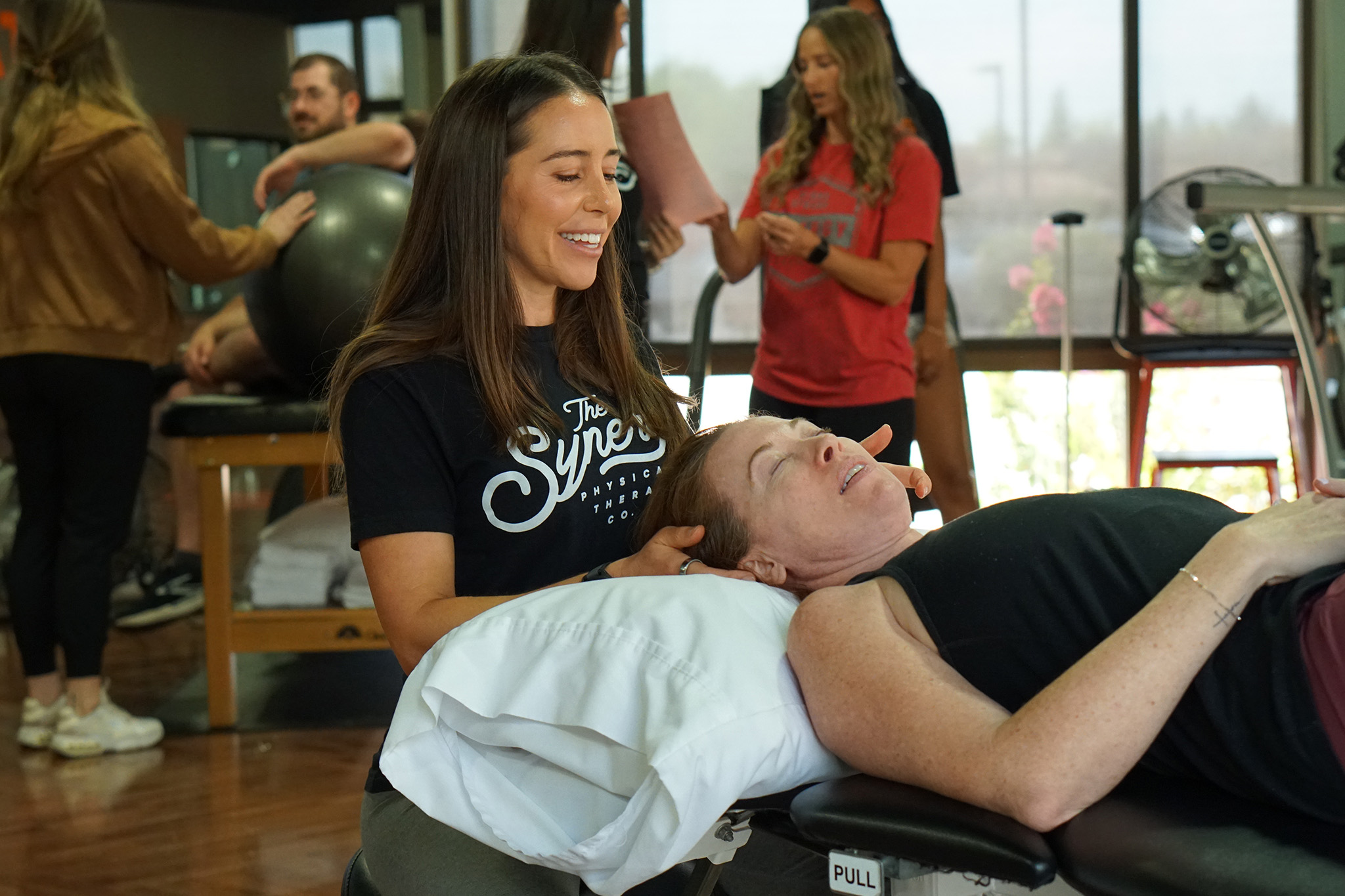
Effective PT for neck pain and cervicogenic headaches is not just heat and ultrasound. It involves hands-on manual therapy to restore movement to the joints of the cervical spine, soft tissue work to address muscle tension and trigger points, specific deep neck flexor strengthening which is consistently deficient in patients with chronic neck pain and headaches, postural and movement retraining, and guidance on workstation setup and daily habits that reduce the load on the cervical spine.
The manual therapy component is particularly important for cervicogenic headaches. Research consistently shows that manual therapy to the upper cervical spine, particularly cervical manipulation and mobilization, produces significant reductions in headache frequency and intensity. Combined with strengthening and postural correction, the results are durable, not just temporary relief.
At Synergy Physical Therapy in Scottsdale, neck and headache patients start with a thorough assessment that includes evaluation of the cervical spine at every level, assessment of shoulder and thoracic mobility which directly affects neck mechanics, and a conversation about your work setup, daily habits, and history of the problem. Treatment is built around what we find, not a standard neck protocol.
Other Neck Conditions We Treat
While the headache connection is one of the most important and least understood aspects of neck pain, we treat the full range of cervical conditions at Synergy:
Common Questions
Tired of Headaches and Neck Pain?
Come find out if your neck is the cause. We offer free consultations for new patients in Scottsdale, and we will give you a clear picture of what is going on and what we can do about it.